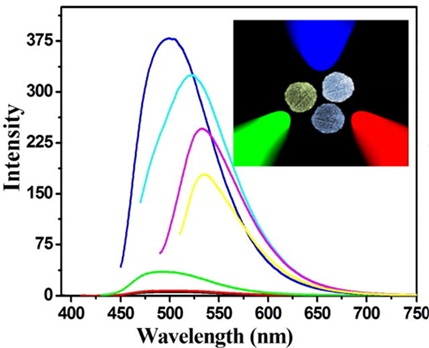
Luminescent nanomaterials are encouraging scaffolds for diverse applications such as chemical sensors and biosensors, imaging, drug delivery, diagnostics, catalysis, energy, photonics, medicine, and so on. Carbon dots (CDs) are a new class of luminescent carbonaceous nanomaterial that have appeared recently and reaped tremendous scientific interest. Herein, we have exploited a simple approach to prepare tuneable and highly fluorescent CDs via surface functionalization. The successful synthesis of CDs is manifested from several investigations like high-resolution transmission electron microscopy (HRTEM), X-ray diffraction (XRD), Fourier transform infrared spectroscopy (FTIR) and X-ray photoelectron spectroscopy (XPS). The CDs exhibit excellent water solubility and with increasing nitrogen content fluorescence quantum yield increases whereas cell toxicity decreases. The CD synthesized at high temperature (180 °C) shows very high quantum yield (more than 56%). The tuneable optical properties of CDs are systematically studied using UV-vis and fluorescence spectroscopy. The cell viability evaluation and in vitro imaging study reveals that the synthesized CDs can be employed as a potential fluorescent probe for bio-imaging without further modification.
Sci. Rep.
Graphene-iodine nanocomposites: highly potent bacterial inhibitors that are bio-compatible with human cells
Surajit Some, Ji Soo Sohn, Junmoo Kim, and 8 more authors
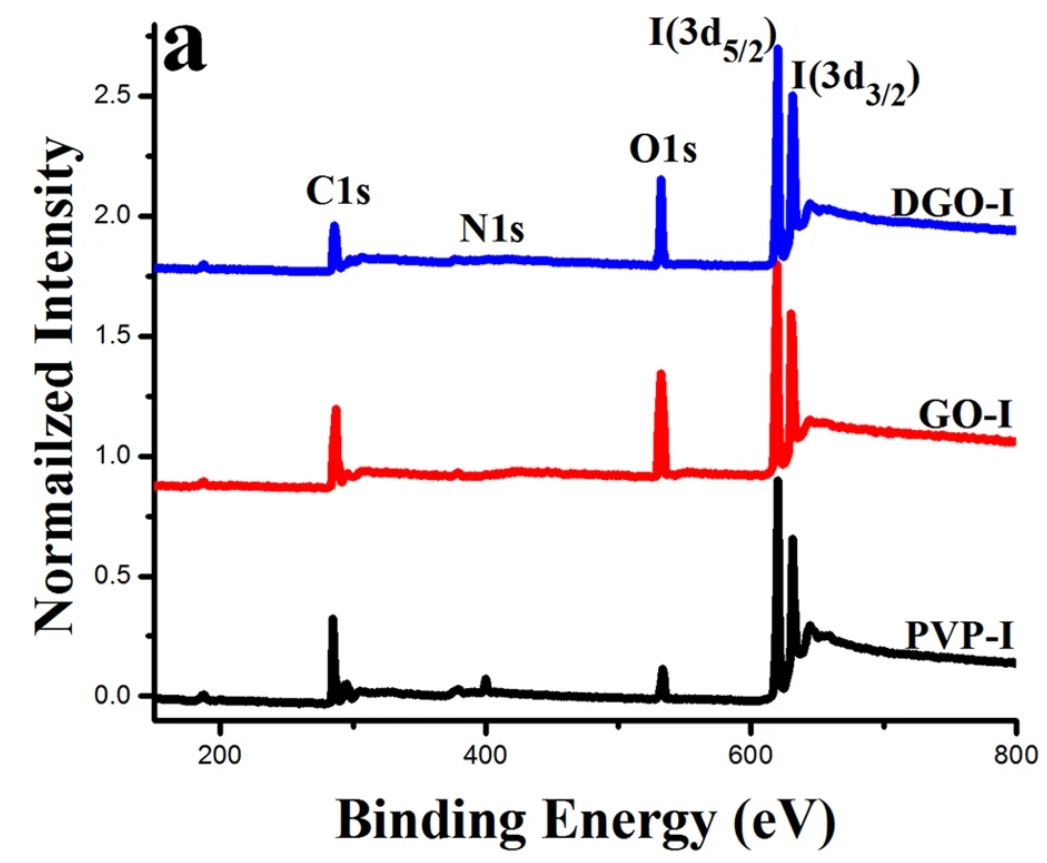
Graphene-composites, capable of inhibiting bacterial growth which is also bio-compatible with human cells have been highly sought after. Here we report for the first time the preparation of new graphene-iodine nano-composites via electrostatic interactions between positively charged graphene derivatives and triiodide anions. The resulting composites were characterized by X-ray photoemission spectroscopy, UV-spectroscopy, Raman spectroscopy and Scanning electron microscopy. The antibacterial potential of these graphene-iodine composites against Klebsiella pneumonia, Pseudomonas aeruginosa, Proteus mirobilis, Staphylococcus aureus and E. coli was investigated. In addition, the cytotoxicity of the nanocomposite with human cells [human white blood cells (WBC), HeLa, MDA-MB-231, Fibroblast (primary human keratinocyte) and Keratinocyte (immortalized fibroblast)], was assessed. DGO (Double-oxidizes graphene oxide) was prepared by the additional oxidation of GO (graphene oxide). This generates more oxygen containing functional groups that can readily trap more H+, thus generating a positively charged surface area under highly acidic conditions. This step allowed bonding with a greater number of anionic triiodides and generated the most potent antibacterial agent among graphene-iodine and as-made povidone-iodine (PVP-I) composites also exhibited nontoxic to human cells culture. Thus, these nano-composites can be used to inhibit the growth of various bacterial species. Importantly, they are also very low-cytotoxic to human cells culture.