Overview
Add a short overview and figures for minimally invasive ECoG / BMI work.
-
A minimally invasive flexible electrode array for simultaneous recording of ECoG signals from Multiple brain regions
Ui-Jin Jeong, Jungpyo Lee, Namsun Chou, and 4 more authors
Lab on a chip, 2021
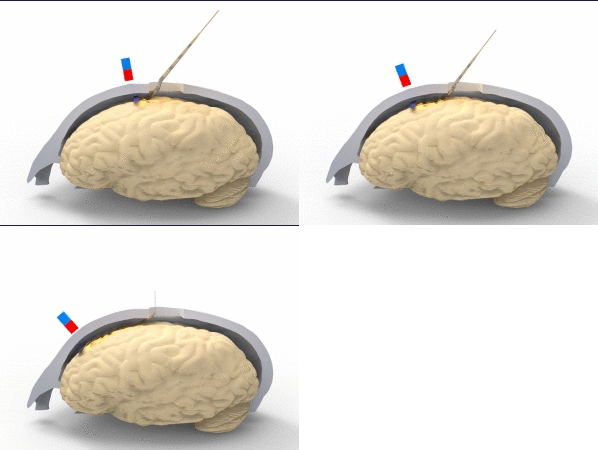
The minimal invasiveness of electrocorticography (ECoG) enabled its widespread use in clinical areas as well as in neuroscience research. However, most existing ECoG arrays require that the entire surface area of the brain that is to be recorded be exposed through a large craniotomy. We propose a device that overcomes this limitation, i.e., a minimally invasive, polyimide-based flexible array of electrodes that can enable the recording of ECoG signals in multiple regions of the brain with minimal exposure of the surface of the brain. Magnetic force-assisted positioning of a flexible electrode array enables recording from distant brain regions with a small cranial window. Also, a biodegradable organic compound used for attaching a magnet on the electrodes allows simple retrieval of the magnet. We demonstrate with an in vivo chronic recording that an implanted ECoG electrode array can record ECoG signals from the visual cortex and the motor cortex during a rat’s free behavior. Our results indicate that the proposed device induced minimal damage to the animal. We expect the proposed device to be utilized for experiments for large-scale brain circuit analyses as well as clinical applications for intra-operative monitoring of epileptic activity.
-
A new MEMS neural probe system integrated with push-pull microfluidic channels and biosensors for real-time monitoring of neurochemicals
Uikyu Chae, Hyoguen Shin, Hyunjoo Jenny Lee, and 8 more authors
In 2016 IEEE 29th International Conference on Micro Electro Mechanical Systems (MEMS), 2016
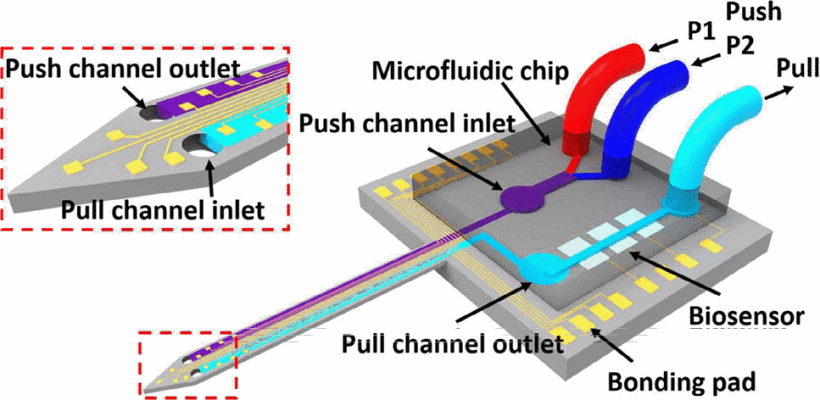
We present a new MEMS neural probe integrated with two microfluidic channels, a mixer, and biosensors for real-time monitoring of neurochemicals and neural activities. The microfluidic channels for push-pull operation of fluids enable infusion of drugs and extraction of brain fluid at the same time. Also, we can simultaneously monitor neural activities modulated by the infused drug. The real-time monitoring of neurochemicals using the monolithically integrated sensors is a new concept we propose which is enabled through the MEMS technology. The proposed system will provide an important new set of information for brain disease investigation and functional brain-mapping.